

Discover the seven engineering factors that define a high-quality racing gearbox. Learn how materials, engineering and manufacturing determine durability, shift quality and long-term motorsport performance.
What Makes a High-Quality Racing Gearbox? 7 Engineering Factors Explained

High-Quality Sequential Racing Gearbox by Kotouč Gearboxes
Professional sequential racing gearbox engineered by Kotouč Gearboxes, featuring a lightweight aluminium housing, precision manufacturing and motorsport-proven engineering.
7 Engineering Factors That Separate Professional Motorsport Gearboxes from Ordinary Transmissions
At first glance, many racing gearboxes appear remarkably similar.
Most feature sequential shifting, straight-cut gears, lightweight aluminium housings and impressive torque figures. Product specifications often list the same number of gears, similar materials and comparable performance claims, making it difficult to understand what truly separates one gearbox from another.
However, experienced engineers know that the real difference lies beneath the surface.
A high-quality racing gearbox is not defined by a single specification or one innovative feature. Its performance is the result of hundreds of engineering decisions made throughout the design, manufacturing and testing process. Material selection, housing stiffness, machining accuracy, lubrication, gear geometry and shift mechanism design all contribute to how the gearbox performs under the extreme conditions of motorsport.
These details become critical during competition.
Repeated standing starts, aggressive downshifts, rapid gear changes, high engine speeds and sustained mechanical loads expose every weakness in the transmission. Under these conditions, even small compromises in engineering or manufacturing can reduce reliability, accelerate wear and ultimately affect lap times.
Choosing the right gearbox is therefore about much more than comparing specifications on a product page.
The most successful race teams evaluate how a gearbox has been engineered, manufactured and optimised for its intended application. They understand that durability, shift quality and long-term performance depend on the complete mechanical system rather than any individual component.
In this article, we explain the seven engineering factors that define a high-quality racing gearbox and what experienced racers, builders and engineers should consider before investing in a professional motorsport transmission.

Precision-manufactured bevel gear set used in high-performance racing gearboxes.
Precision-engineered bevel gear set manufactured by Kotouc Gearboxes for maximum durability, efficient power transmission and reliable performance under the extreme demands of professional motorsport.
1. Materials Are the Foundation of Every High-Performance Gearbox
Every racing gearbox begins with one fundamental decision: the choice of materials. No matter how advanced the design or how precise the manufacturing process, the gearbox can never outperform the materials from which it is built. Every internal component experiences different mechanical loads.
Gears repeatedly transfer engine torque through direct tooth contact while absorbing shock loads during aggressive gear changes. Shafts are subjected to continuous torsional forces. Bearings must support radial and axial loads at extremely high rotational speeds. Selector forks and engagement components complete thousands of movement cycles throughout a racing season.
Because each component performs a different function, professional gearbox manufacturers rarely rely on a single material throughout the entire transmission.
Instead, every component is manufactured from materials selected specifically for its mechanical requirements.
High-strength alloy steels are typically chosen for gears due to their excellent fatigue resistance and wear characteristics after heat treatment. Shafts require materials capable of resisting torsional deformation while maintaining dimensional stability under continuous load. Housings must combine low weight with exceptional rigidity, while selector components need both precision and resistance to repeated contact stresses.
Material quality extends beyond the steel grade itself.
Certified raw materials provide consistent chemical composition, controlled grain structure and predictable mechanical properties. These characteristics significantly reduce the likelihood of fatigue-related failures and ensure consistent performance throughout the gearbox's service life.
In motorsport, failures often originate long before the race begins.
A gearbox may fail not because the driver exceeded its limits, but because compromises were made during material selection or manufacturing. Small differences in metallurgy can have a substantial impact on fatigue resistance, wear behaviour and long-term durability.
This is why premium gearbox manufacturers work closely with certified material suppliers and apply strict quality control throughout the production process.
The result is a transmission engineered not only for maximum performance but also for predictable reliability under the demanding conditions of professional motorsport.
Engineering Insight
Two racing gearboxes may look almost identical externally, yet their long-term durability can differ dramatically. Material certification, alloy composition and heat treatment quality often determine whether a gearbox performs reliably over multiple racing seasons or requires frequent rebuilds.
Key Takeaways
- Materials determine durability, fatigue resistance and long-term reliability.
- Different gearbox components require different alloy steels.
- Certified materials provide consistent mechanical properties.
- High-quality metallurgy significantly reduces the risk of fatigue failures.
- Premium materials create the foundation for every professional racing gearbox.
2. Engineering Design Determines Performance
Exceptional materials alone cannot create an exceptional gearbox. The real performance of a racing transmission is established during the engineering phase, long before the first component is machined.
Professional motorsport gearboxes are designed as complete mechanical systems. Every shaft, bearing, housing, selector mechanism and gear must work together while maintaining precise alignment under extreme torque, vibration and thermal loading.
Engineering is therefore a process of optimisation rather than simply making every component stronger. For example, increasing shaft diameter may improve torque capacity, but it also increases rotating mass. A thicker gearbox housing may improve stiffness, yet unnecessary weight negatively affects vehicle dynamics. Larger gears may transmit more torque but also require additional space, increasing overall transmission size and inertia.
The objective is to achieve the optimal balance between strength, weight, efficiency and durability.
Modern gearbox development relies heavily on advanced engineering software. Three-dimensional CAD models allow engineers to optimise every component before manufacturing begins, while Finite Element Analysis (FEA) predicts stress concentrations, housing deformation, shaft deflection and bearing loads under simulated racing conditions. These digital tools enable potential weaknesses to be identified before a single component enters production.
Housing stiffness is another critical engineering consideration. Many people assume the gearbox housing merely protects the internal components. In reality, it acts as the structural backbone of the entire transmission.
If the housing flexes under load, shaft alignment changes, gear contact patterns shift and bearing loads increase. Even microscopic movement can accelerate wear and reduce long-term reliability.
Lubrication must also be integrated into the design from the beginning. A well-engineered gearbox ensures that gears, bearings and engagement components receive a continuous supply of lubricant during acceleration, braking and sustained cornering. Effective oil distribution reduces friction, lowers operating temperatures and significantly extends component life.
Professional engineering also considers future maintenance. Motorsport transmissions are expected to undergo regular inspection, gear ratio changes and rebuilds. Modular construction, accessible components and efficient assembly layouts reduce service time while simplifying future upgrades.
Ultimately, outstanding gearbox performance is achieved through hundreds of carefully engineered details working together as one integrated system.

Kotouč Gearboxes CNC Precision Machining
Precision CNC-machined aluminium component manufactured by Kotouč Gearboxes, demonstrating the accuracy, surface finish and engineering quality required for professional motorsport applications.
3. Precision Manufacturing Turns Great Engineering into Reliable Performance
Designing an exceptional racing gearbox is only the beginning. The true challenge is manufacturing every component with the same level of precision that was achieved during the engineering phase. Even the most sophisticated design can underperform if machining tolerances, surface finishes or assembly accuracy fail to meet specification.
In professional motorsport, tolerances are measured in hundredths—or even thousandths—of a millimetre. Small deviations that may have little impact in a road car transmission can significantly influence gear engagement, bearing life and shifting consistency in a racing gearbox operating under extreme loads.
Every component matters. Gears must mesh precisely to distribute load evenly across the tooth surface. Shafts require perfect concentricity to minimise vibration and bearing stress. Bearing seats must maintain exact dimensions to achieve the correct preload. Selector components need to move smoothly while maintaining precise alignment during every gear change.
Achieving this level of precision requires far more than modern CNC machinery. High-quality manufacturing depends on the entire production process: cutting strategies, tooling quality, fixture design, machining parameters and continuous inspection.
Each machining operation builds upon the previous one. If a small dimensional error is introduced during an early manufacturing stage, it may affect every subsequent process. Professional manufacturers therefore perform quality checks throughout production rather than relying solely on a final inspection.
Coordinate Measuring Machines (CMM), precision gauges and surface roughness measurements verify that every critical dimension meets engineering specifications before assembly begins.
Surface finish is another important factor that is often overlooked. Although two gears may appear identical to the naked eye, microscopic differences in surface quality influence friction, lubrication and wear throughout the gearbox's service life. Reducing surface roughness improves oil film stability, lowers operating temperatures and contributes to smoother gear engagement.
Repeatability is equally important. A professional gearbox manufacturer must be able to produce replacement components years after the original gearbox was delivered while maintaining identical fit and performance. Consistent manufacturing standards ensure that rebuilt or upgraded transmissions continue to perform exactly as intended.
Ultimately, precision manufacturing transforms engineering theory into reliable motorsport performance.
Engineering Insight
Precision is not measured by how accurately one gearbox is manufactured—it is measured by how accurately every gearbox is manufactured. Consistency is one of the defining characteristics of professional motorsport engineering.
Real-World Example
Imagine two sequential gearboxes installed in identical race cars. Both have the same gear ratios, the same materials and the same torque rating. However, one gearbox has slightly inaccurate bearing preload and minor shaft misalignment caused by manufacturing tolerances. Initially, the difference may be impossible to notice. After several race weekends, however, increased bearing loads lead to higher operating temperatures, accelerated wear and reduced shift quality. This illustrates why precision manufacturing has such a profound effect on long-term reliability.
Key Takeaways
- Precision machining directly affects durability and shift quality.
- Tight tolerances reduce friction and component wear.
- Surface finish influences lubrication and efficiency.
- Continuous quality control is essential throughout manufacturing.
- Repeatability ensures long-term serviceability and spare parts compatibility.
4. Lightweight Construction Is About Optimisation, Not Minimum Weight
One of the biggest misconceptions in motorsport is that the lightest gearbox is automatically the best. In reality, professional engineers rarely pursue the lowest possible weight. Instead, they optimise the strength-to-weight ratio.
Every kilogram removed from the transmission contributes to improved vehicle dynamics. Lower mass benefits acceleration, braking and handling, while lighter rotating components reduce drivetrain inertia and improve throttle response.
However, aggressive weight reduction introduces significant engineering challenges. Removing too much material from the housing or rotating components may reduce stiffness and fatigue resistance, ultimately shortening gearbox life.
Professional gearbox manufacturers therefore use engineering simulations rather than guesswork. Finite Element Analysis (FEA) identifies areas where material contributes little to structural integrity. These regions can be optimised without compromising strength, while highly stressed areas remain reinforced.
The gearbox housing is a perfect example. Far more than a protective enclosure, it maintains precise shaft alignment under high torque loads. If the housing flexes during acceleration or aggressive gear changes, gear contact patterns change, bearing loads increase and wear accelerates. This is why housing rigidity is often more important than achieving the absolute lowest weight.
The same philosophy applies to rotating components. Reducing the mass of gears, shafts and selector drums lowers rotational inertia, allowing the drivetrain to respond more quickly to throttle inputs. However, these components must still withstand repeated shock loads throughout the racing season.
Professional engineering is therefore about intelligent optimisation rather than removing material wherever possible. The fastest gearbox is not necessarily the lightest—it is the gearbox that achieves the best balance between weight, stiffness, durability and efficiency.
Engineering Insight
A lightweight Formula Student gearbox and a gearbox designed for a 1,400 kg AWD rally car require completely different engineering priorities. Optimisation always depends on the intended application.
Key Takeaways
- Lower weight improves vehicle dynamics.
- Structural rigidity remains essential.
- FEA allows engineers to remove unnecessary material safely.
- Reduced rotating mass improves drivetrain response.
- Strength-to-weight ratio is more important than minimum weight.

Kotouč Gearboxes Hydraulic Paddle Shifting Unit
Hydraulic paddle shifting unit by Kotouč Gearboxes, engineered for fast, precise and reliable sequential gear changes in professional motorsport applications.
Precise Shifting Mechanism Builds Driver Confidence
For many drivers, shift quality defines the entire driving experience. A professional sequential gearbox should deliver fast, accurate and repeatable gear changes regardless of engine speed or racing conditions.
This level of performance depends on much more than strong gears. The shifting mechanism is a complete system consisting of the selector drum, selector forks, engagement sleeves and dog rings, with every component operating together at exceptional precision.
Unlike an H-pattern gearbox, where the driver selects gears manually through multiple shift gates, a sequential transmission rotates the selector drum through a fixed movement. Precisely machined cam tracks guide the selector forks into the correct position during every shift, while their geometry significantly influences engagement quality, friction and long-term durability.
Selector forks must combine rigidity with low weight. Any unwanted flex reduces engagement accuracy and accelerates wear of both the forks and the engagement components. Kotouc Gearboxes excels in this field where other manufacturer fail constantly. For example, look at the manufacturing of the Kotouc Gearboxes selector fork compared to another option.
Kotouc Gearboxes sequential gearboxes are designed with minimal shift travel, allowing faster gear changes while reducing driver workload. Electronic systems such as flat shift and ignition cut strategies can further improve shift speed by temporarily reducing engine torque, but they only perform as intended when combined with a precisely engineered gearbox. Poor internal geometry cannot be compensated for by electronics alone.
The best sequential gearboxes inspire confidence. Every shift feels positive, mechanical and predictable, allowing the driver to focus entirely on braking points, racing lines and vehicle balance rather than wondering whether the next gear has engaged correctly.
Engineering Insight
Missed shifts rarely occur because of driver error alone. Internal geometry, selector drum design, dog ring engagement and manufacturing precision all influence shift quality under demanding racing conditions.
Key Takeaways
- Shift quality depends on the complete mechanism, not only the gears.
- Selector drum geometry directly influences engagement precision.
- Strong selector forks maintain accurate alignment.
- Short shift travel enables faster gear changes.
- Mechanical precision and electronic shift strategies work together to deliver maximum performance.

6. Gear Tooth Profile: The Hidden Engineering Behind Performance
At first glance, two racing gears may look virtually identical. In reality, their geometry may differ significantly, influencing everything from efficiency and durability to shift quality and maximum torque capacity.
Gear tooth design is one of the most technically demanding aspects of gearbox engineering, yet it remains almost invisible to anyone looking at a finished transmission. Every tooth must repeatedly transmit extremely high forces while maintaining a stable oil film and minimising friction.
Achieving this requires careful optimisation of multiple engineering parameters, including:
- tooth profile geometry
- pressure angle
- root radius
- contact ratio
- tooth thickness
- surface finish
Each of these characteristics affects how forces are distributed during operation. A poorly designed tooth profile concentrates stress in small contact areas. Over time, this increases the risk of pitting, micro-cracking and fatigue failure.
By contrast, an optimised profile distributes loads more evenly across the tooth surface, reducing peak stresses and significantly extending service life.
The geometry also influences efficiency. Poor contact patterns generate additional friction, increasing operating temperatures and reducing the effectiveness of the lubrication film. Even small improvements in tooth geometry can reduce heat generation while improving long-term reliability.
Surface finish is equally important. Following precision machining and heat treatment, many professional manufacturers apply advanced finishing processes to further improve surface quality. One example is REM Isotropic Superfinishing, which reduces microscopic surface asperities without altering the designed gear geometry.
The benefits include:
- Lower friction
- Improved lubricant retention
- Reduced operating temperatures
- Smoother gear engagement
- Longer component life
This is particularly valuable in endurance racing, where gearbox temperatures remain elevated for extended periods.
Gear geometry should also reflect the intended motorsport discipline. A rally gearbox experiences repeated shock loads during launches and rapid weight transfer, while a circuit racing gearbox operates under sustained high-speed conditions with long periods at maximum engine load. Drag racing introduces extreme torque spikes during launches. These applications require different engineering priorities, even when engine power is similar.
There is no universal gear profile that performs best in every discipline. Instead, professional gearbox manufacturers optimise gear geometry for the specific application. This engineering philosophy produces transmissions that deliver maximum durability, efficiency and predictable performance under real racing conditions.
Engineering Insight
Gear tooth geometry is one of the least visible aspects of a racing gearbox, yet it has one of the greatest influences on durability, efficiency and long-term reliability.
7. Torque Rating Is More Than Just a Number
One of the first specifications many customers compare is torque rating. Figures such as 500 Nm, 700 Nm or even 1,000 Nm often appear impressive on a specification sheet. However, torque rating alone tells only part of the story.
Two gearboxes with the same published torque rating can perform very differently depending on how they have been engineered and how they are used.
Peak engine torque is only one variable. Professional gearbox manufacturers evaluate many additional factors before determining whether a transmission is suitable for a particular application.
These include:
engine characteristics
drivetrain layout
vehicle weight
tyre grip
intended motorsport discipline
launch strategy
service intervals
driving style
Consider two vehicles producing exactly 600 Nm. The first is a lightweight rear-wheel-drive Time Attack car. The second is a heavier all-wheel-drive rally car competing on gravel. Although both engines generate the same peak torque, the gearbox in the rally car experiences significantly higher shock loads due to increased traction, vehicle mass and repeated launches.
Turbocharged engines introduce another challenge. Unlike naturally aspirated engines, they often produce rapid torque spikes that place additional stress on gears, shafts and engagement components. Launch control systems, anti-lag and aggressive clutch engagement further increase instantaneous loading. These short-duration shock loads may exceed the engine's measured torque output.
This is why experienced manufacturers rarely recommend a gearbox based solely on engine power. Instead, they assess the complete vehicle package. Material selection, housing stiffness, shaft support, gear geometry, lubrication and bearing arrangement all contribute to the gearbox's real-world torque capacity.
Ultimately, torque rating should be viewed as an engineering guideline rather than an absolute limit. The best racing gearbox is not the one with the highest advertised torque figure. It is the gearbox specifically engineered for your vehicle, your engine and your intended motorsport application.
Selecting the right gearbox also means choosing the correct gear ratios for your engine, tyre size and intended motorsport discipline. To estimate the ideal balance between acceleration and top speed, try our Gear Ratio Calculator.
Engineering Insight
Two race cars producing identical engine torque can impose completely different loads on the transmission. Vehicle weight, traction and drivetrain configuration often influence gearbox loading more than peak torque itself.
Key Takeaways
- Torque rating should never be considered in isolation.
- Vehicle characteristics influence gearbox loading as much as engine torque.
- Shock loads often exceed measured engine torque.
- Engineering quality determines real-world durability.
- The ideal gearbox is selected according to the complete application rather than a single specification.
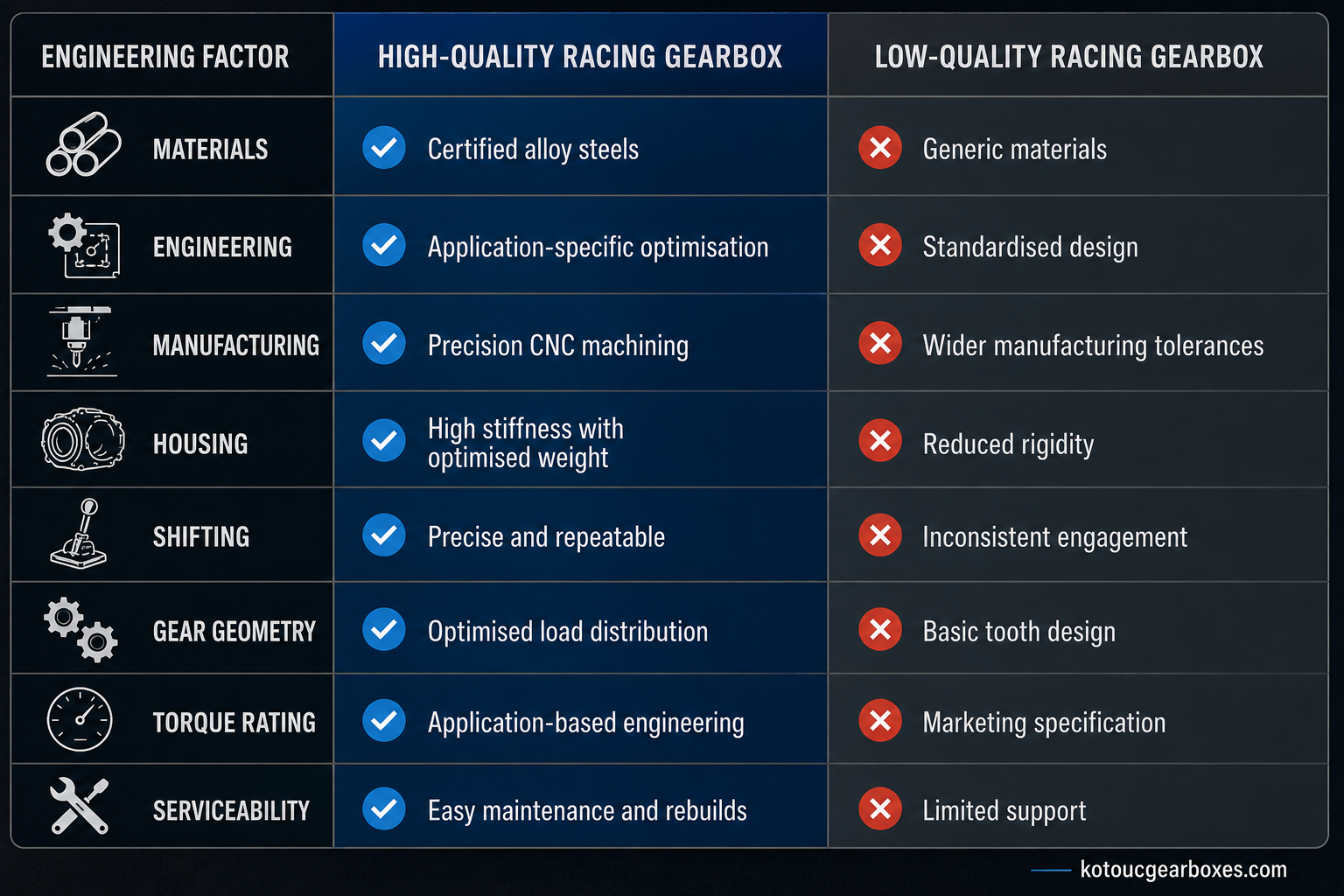
High-Quality vs Low-Quality Racing Gearbox Comparison
Comparison of the key engineering differences between a high-quality racing gearbox and a low-quality gearbox, including materials, manufacturing precision, shifting performance and torque rating.
Common Mistakes When Buying a Racing Gearbox
Selecting a racing gearbox is a major investment. Unfortunately, many buyers focus on specifications that reveal only a small part of the overall picture.
Some of the most common mistakes include:
Choosing solely by torque rating
Published figures rarely tell the whole story. Always consider the intended application rather than comparing numbers alone.
Buying based only on price
Lower purchase cost may result in significantly higher maintenance and rebuild costs over the life of the gearbox.
Ignoring serviceability
Professional motorsport transmissions should be designed for straightforward inspection, maintenance and gear ratio changes.
Overlooking manufacturer support
Technical expertise and engineering advice often become just as valuable as the gearbox itself.
Assuming every sequential gearbox is the same
Although many products appear similar externally, significant differences exist in engineering quality, manufacturing precision and long-term durability.
Ready to Choose the Right Racing Gearbox?
Selecting the right racing gearbox involves much more than comparing specifications. Every project has unique requirements based on engine characteristics, vehicle weight, drivetrain layout and intended motorsport discipline.
At Kotouč Gearboxes, every transmission is engineered around your application—not the other way around.
Whether you're building a rally car, circuit racer, hillclimb machine or Time Attack project, our engineering team can help you select the optimal gearbox configuration for maximum performance, reliability and long-term durability.
Contact Kotouč Gearboxes today to discuss your project and find the ideal transmission for your motorsport application.